
When the Mirror Becomes the Measure
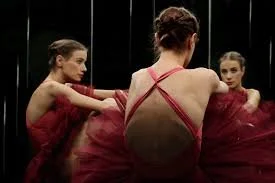
Dancers can become trapped in a studio of mirrors, where a distorted reflection begins to feel more real than the dancer themselves.
Not because they are taught to see this way,
but because over time, the mirror quietly shifts from a tool into a measure.
What begins as observation becomes evaluation.
And what was meant to support learning begins to shape identity.
There is a mirror in nearly every ballet studio.
We rely on it. We trust it. We rarely question it.
It offers immediate feedback—line, placement, coordination.
And in many ways, it is useful.
But the mirror does not simply show movement.
It shapes how movement is perceived.
Because many dancers are not looking to understand what their body is doing.
They are looking to decide how it looks.
And those are not the same thing.
Over time, this distinction matters.
When the mirror becomes a place of constant evaluation, attention begins to narrow.
The eye is drawn to what feels wrong.
To what does not meet expectation.
To the detail that never quite settles.
And in that narrowing, the dancer can lose sight of the whole.
The mirror does not teach coordination.
It does not teach timing, grounding, or presence.
It cannot show what the audience experiences—
nor can it reveal projection or spatial intention.
It offers a single perspective—reversed, fixed, and external—
while the dancer is living inside the movement itself.
And still, we need it.
Because when used with intention, the mirror can support learning.
It can offer clarity.
It can reinforce spatial awareness and group coordination.
But it must remain what it was meant to be:
a tool, not a measure.
Perhaps the shift is not to remove the mirror,
but to change the relationship.
To move from constant checking
to deliberate seeing.
To ask dancers to look, gather information,
and then return to sensation.
Sometimes, this means turning away from the mirror—
not as a correction, but as an invitation.
An invitation to feel the movement organize from within.
To stabilize without visual dependency.
To trust what is developing, even when it cannot be seen.
Because the mirror will always reflect something.
But it does not always reflect the truth of the dancer.
This does not require removing the mirror.
But it does ask for more intentional use.
Invite dancers to look with purpose, then look away.
Encourage them to take in information and return to what they feel.
Ask them to see the whole body, not just the part they are most critical of.
To widen their attention, rather than narrow it.
At times, turn them away from the mirror entirely—
not to take something away, but to give something back:
their internal sense of coordination, balance, and presence.
And remind them, gently,
that what they see is not the full story.
Because there is a deeper layer to this that we do not always name.
The mirror does more than reflect the body—
it often becomes a place where dancers quietly form judgments about themselves.
And those impressions can linger.
But the truth is, a mirror was never meant to define a person.
It cannot measure growth.
It cannot capture effort, resilience, or becoming.
It cannot reflect the fullness of who a dancer is.
And from a deeper perspective, it was never meant to.
Because our worth was never designed to be determined by reflection—
but by creation.
Scripture reminds us that we are “fearfully and wonderfully made” (Psalm 139:14),
formed with intention, not evaluated into value.
And while a mirror may show an image,
it cannot speak truth.
It cannot tell a dancer who they are.
It cannot define their identity.
It cannot measure what God is forming beneath the surface—
in perseverance, in discipline, in quiet growth.
If dancers begin to anchor their understanding not in what is seen,
but in what is true,
the relationship begins to shift.
Not away from discipline.
Not away from refinement.
But toward something more grounded.
More stable.
More whole.
Because the goal is not simply to see the body more clearly.
It is to understand it.
To develop it.
And, over time, to trust it.
And perhaps even more than that—
to remember that who they are
was never meant to be measured by a mirror in the first place.
When the mirror becomes the primary reference point, dancers may begin to rely on what is seen rather than what is sensed, organized, and communicated.
Guiding dancers beyond visual dependence requires careful attention to how awareness is developed in training.