
When My Body Can No Longer Show What I Know
Reflections on demonstration, physical change, and an evolving identity as a ballet teacher.
For much of my teaching career, my body was one of my primary teaching tools.
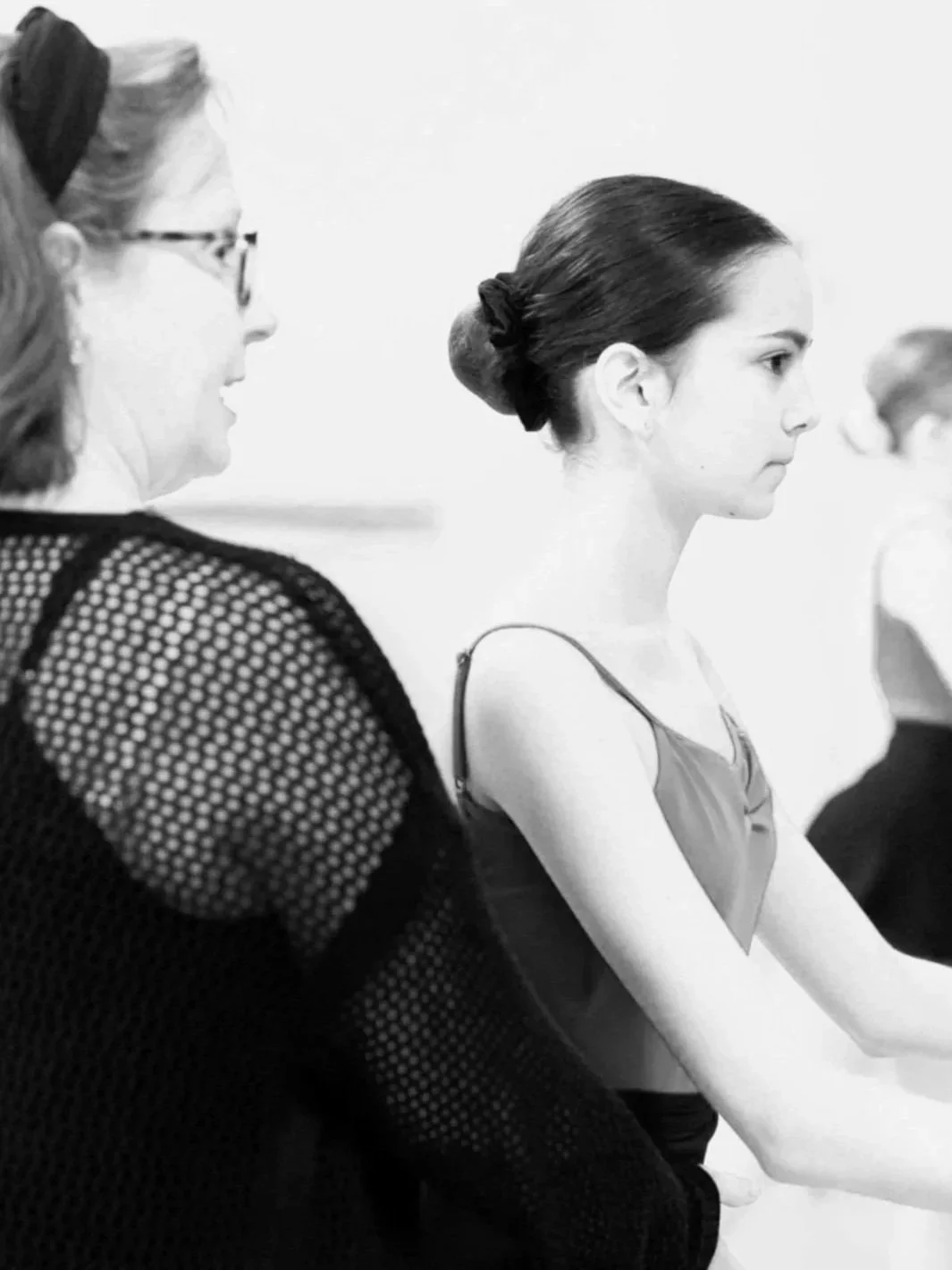
What remains.
“Although my demonstrations have changed, my ability to observe has not disappeared.”
If words were not enough, I could demonstrate. If a student misunderstood, I could show the movement from another angle, change the timing, exaggerate the coordination, or place the correction within the full step. I could demonstrate, observe, analyze, correct, and demonstrate again.
That process felt natural. I did not have to think very much about what it meant to rely upon my body as part of my teaching expertise.
Now I do.
My body has changed, and I can no longer demonstrate everything as fully or easily as I once could. Sometimes I modify the movement. Sometimes I mark it. Sometimes I demonstrate only the arms, head, rhythm, or directional pathway. Sometimes I explain instead. When I need a complete physical model, I may ask another dancer to demonstrate.
These are reasonable adaptations. I know that.
But knowing they are reasonable does not make the change easy.
When a Student Asks Me to Show It
There is a moment that has become increasingly difficult for me.
I explain a movement carefully. I break down the coordination, clarify the rhythm, and describe what the dancer should feel or understand. Then a student looks at me and asks:
“Can you demonstrate it?”
The question is not unkind. The student is not questioning my knowledge or trying to embarrass me. The student simply needs to see the movement.
And sometimes I cannot show it in the way the student needs.
That is frustrating. It is also disappointing.
I know what the movement should be. I can see it clearly in my mind and recognize it immediately in another body. I can identify why an attempt is not working and what needs to change. But knowing and physically showing are no longer always the same thing for me.
In those moments, I sometimes question whether my words are enough. I wonder whether I can still give the student what they need—especially when I am teaching young dancers or beginning adults.
Some Students Need the Physical Model
Young dancers often rely heavily upon demonstration. They may not yet have the movement vocabulary, body awareness, spatial understanding, attention, coordination, or memory needed to translate a verbal explanation into physical action.
Beginning adult students may understand the words but still need to see how the parts fit together. They may comprehend the idea intellectually while their bodies remain unsure of the timing, weight transfer, shape, or sequence.
I can offer an excellent explanation, but an excellent explanation is not necessarily an accessible explanation for the person standing in front of me.
Sometimes students need to see the movement.
That reality makes my changing physical capacity more complicated than simply deciding to “teach with my words.” Ballet is embodied. Demonstration matters. I cannot pretend otherwise simply because demonstrating has become more difficult for me.
The Frustration Beneath the Adaptation
I have learned to make adjustments.
I mark movements. I demonstrate what I can. I isolate one part of the coordination. I use imagery, rhythm, questions, anatomical explanations, and spatial cues. I ask a student to serve as the physical model while I direct everyone’s attention toward what I want them to notice.
These strategies work. Some of them have made me a more thoughtful teacher.
But there are days when I do not want to find another strategy. I want to stand up and demonstrate the movement as I remember being able to do it.
I want the immediacy of showing rather than explaining.
I want my physical knowledge and my physical capacity to feel like they belong to the same body again.
There is grief in that distance.
Dance teachers do not always talk about what happens when the body that established so much of our professional identity begins to change. We may still possess decades of knowledge, but we also inhabit a profession in which physical ability is highly visible. Demonstration can become intertwined with credibility—not only in the minds of students, but in our own minds as teachers.
If I cannot show everything, am I still the teacher I was?
Perhaps the honest answer is no.
I am not exactly the teacher I was. I am having to become a different teacher.
What Remains
Although my demonstrations have changed, my ability to observe has not disappeared.
I can still recognize when a dancer has not transferred weight fully. I can see when the pelvis has shifted, when the supporting side has collapsed, when turnout has moved into the feet, or when the rhythm has been copied without being understood.
I can recognize the difference between a dancer who needs more strength and one who needs a clearer explanation. I can see when the problem is balance, sequencing, coordination, confidence, attention, or insufficient preparation.
I can still analyze movement. I can still connect one stage of learning to the next. I can still help dancers and teachers understand why something is not working.
Ballet knowledge does not live only in performance.
It also lives in memory, perception, experience, analysis, and discernment.
The wisdom is still embodied, even when its physical expression changes.
An Identity That Is Still Changing
I am still working through what this means for my identity as a teacher.
Part of me wants to move away from the daily physical demands of studio teaching and devote more of my work to curriculum development and teacher education. That is where I increasingly feel drawn. I want to help teachers recognize prerequisite gaps, understand movement development, and build programs that support how dancers actually learn.
At the same time, I sometimes fear that stepping away from regular studio teaching will make my experience appear less relevant. I wonder whether people will trust my curriculum work if I am no longer demonstrating and teaching in the same way or with the same frequency.
That fear is real.
But so is the knowledge that my curriculum work exists because of what I have seen in the studio. It has been shaped by years of watching dancers learn, misunderstand, compensate, struggle, discover, and grow. My current challenges are not separating me from that work. They are causing me to examine it more deeply.
I am beginning to understand that curriculum development is not what I do because I can no longer demonstrate everything.
It is work I am uniquely prepared to do because I understand what lies beneath the demonstration.
Still Learning How to Teach This Way
I do not have a perfectly resolved conclusion.
I am still disappointed when my body cannot do what my mind remembers. I still feel exposed when a student asks for a demonstration I cannot fully provide. I am still learning when to mark, when to explain, when to use another dancer, and when to acknowledge honestly that my body has limitations.
But I am also learning that my authority as a teacher does not rest entirely upon my ability to perform every movement.
My body may no longer be able to show everything I know.
That does not mean the knowledge is gone.
The demonstrations may change. The teaching may change. My professional role may continue to change.
The wisdom remains.
And I am still learning how to trust what it can become.